
|
|
|
Out of foundation and into the mind-body problem, part three In July and August of 2021, James Bowery and I became embroiled in a productive debate about, as James eventually titled it, the causal structure of Dasein. I am returning to that subject now, because I find I cannot proceed with my Part Two NSDAP essay without doing so. My thanks to James for his participation and commentary on that thread, which was to his film review here .
Let us begin this essay by reminding ourselves why such abstract and theoretical subject matter, which attends to a primordial aspect of human existence of surpassing irrelevance to those contesting the politics of the day, is nevertheless necessary and meaningful for us as nationalists. How we came to the point of needing new thinking For the reason, in brief, that since the Greeks, Western thinking has been overly concentrated on the technical question of how can we know truth and not the existential who are we … For the reason that Christianity’s idiosyncratic model of the sinner seeking a personal salvation post-mortem by the grace of God does not, in fact, tend to Man’s relational truth but moves him in a manner wholly consistent with the Judaic End-Time ... For the like reason, following on from Christianity’s universalist dictum that all men are equally made in the image of God, an entire eco-system of narratives of injustice and oppression has been politicked into being, every type of it, every detail, targeting the white sexually-normal male as a bearer of an original sin of some kind, most usually racism ... For the reason that liberalism’s unfettering will - the guiding idea of our epoch and the secular child of Christianity - is a non-real and non-possible desideratum, the pursuit of which can only consume our lives and distance us from our innate truth ... For the reason in consequence that Western metaphysics has not been able to centre itself on the human principle but has surrendered it to science and technology, reducing the lived life to mere utility filled with economism, materialism, and consumption-as-progress ... For the reason that investment, banking, corporate, media and tech elites, and the internationalist institutions, hold sway over the liberal democratic system, and thus over the parties and governments of the West also, imposing their agendas on national politics and reducing it everywhere to a ritual of deception and betrayal … For the reason that since the middle of the 19th century the Jewish ethno-religious paradigm has accommodated itself, via the leading Jewish intellectuals and activists, in the development of Western philosophical, political and cultural life, colouring political decision to the profound exclusion of our own interests and freedom … For the reason that we have no recourse to an active politics of those interests and of the truth of our person, indeed a war of false morality is waged against these even while our ancestral homelands are deliberately and wickedly flooded with foreign populations (which are no less wickedly presented to us as “oppressed peoples” and “ethnic minorities”) ... … for such reasons, great and small, we are not only subject to the soft-genocidal power play of global elites but to an acquired inner condition of estrangement and confusion. The modern life so ceaselessly and seamlessly manufactures artifice, the stranger within us reacts to the mortal danger to our kind not with love and commitment to putting things straight but with perfect insouciance. “What does it matter to me?” the stranger may ask. Because, of course, in artifice and its detachments lies self-referentialism and nihilism. So we all sleep on while, to borrow from Enoch Powell, our elites and others hostie to us heap up the European demographic funeral pyre, and drag the European man and woman and the European family through their neo-Marxist sewer. In such a compromised condition, from whence is the capacity to defend our life and being to come? If it comes only from the anti-globalist and traditionalist right as represented by the phenomenon that is Giorgia Meloni, and by the rise of Jimmie Åkesson and the Sweden Democrats, and AfD in Germany, by the revitalisation of Marine Le Pen, perhaps even in the person of Donald Trump, then we will see gestures in the direction of recovery, for sure. But none of these will ever sweep away modernity and the mass man, or the Money Power, never mind the more subtly enworlding powers of the West’s deep religious and ethical, philosophical, social, economic and cultural forms … its very models of Life and Man and their complete possession by the Jewish spirit. Likewise, none of our own discursive efforts to this point … on race and immigration, on the JQ, on cultural Marxism, on Islam, and latterly on globalism and the Money Power … will ever measure up to this world-making task. Reaction might reform to one or another degree. But it does not replace the system which is formative to us, which abides within us, and which we effortlessly communicate to our children. Yet any measure less than replacement of that formative system and the cut will be too shallow. The default characteristic of the system will prevail, and its DNA will carry over to confound, limit, frustrate, outlast, and swallow all the forces of reaction. All that was before reaction will be after it. Preparatory notes for a critical Heideggerian So we return to this question of the abstract, the theoretical, because that is the language in which the formative is re-conceptualised and brought anew to the world. Only thus could a new and complete philosophy for life and truth, emerging from the human fundamentals, be brought forth. Only thus could nationalists properly defy our historical trajectory, change it and become the driving force of a revolution for existence. But why being? Why so tenuous and recondite a principle, and why Martin Heidegger’s idiosyncratic account of it? Well, is it not both the very substrate of the social dimension and the witness to, and participant in, pure reality? And was not epochal change Heidegger’s stated goal when, a century ago, he sat down to pen the first paragraphs of what would, four years later, appear as Being and Time? And here we are, still waiting for the epoch of being. While, in the meantime, his thought has become key to large swathes of later political thinking, little to nothing of it doesn’t smuggle in Marxian or Freudian argument, or relativism, or hyper-individualism. Change in our life there has been, but none of what Heidegger intended, and nothing to help us. Of course, Heidegger never wrote Being and Time’s anticipated sequel. What we do have is substantially modified by his much quoted “turn” during the 1930s from one central concept to another ... from Dasein as the principal active element in human being-in-the-world to Beyng as the driver and discloser of our emergence from the great neurological jig-saw puzzle that is being-in-reality. But, in fact, these are not the only two directions we could go. Including them, we might distinguish at least four paths: (i) Dasein as human being in the world, ie, the standing within our own individual being (for it is not a collective entity, and definitively not our psychology or consciousness) to witness and receive the existential meaning of the organic and inorganic and its world-hood. This is “early” Heidegger’s general account of our existence with which he (somewhat selectively) opposes classical Cartesian epistemology. His rigorous exclusion of psychology means that it is not detailed in such a way as to incorporate … (ii) The tragedy of absence of our native and optimal state of being-here-now from our consciousness, overtaken as it is by an habitual falling into self-obscuration and mechanicity. The very stuff of the world of men, with all its error, darkness and travail, flows from this vast interior failing, which is in part inevitable since human cognition never quite captures the quicksilver instant of the real. A principal reason for that is the slowness and cumbersomeness of the thinking process, with its reliance on association (and memory, therefore), ideation, and language. As it is ordinarily the seat of consciousness, humans can only be-here-now by detaching from it in so far as possible and for what brief passage of time they can, and attaching to the physical or sensation-based Mind. Monastics may do so under certain conditions, but for the rest of us that part of our fallenness is beyond redress. But then there is the other part, which is of our enworldment and its mechanical formation of our personhood. In that respect even a small correction to the people’s consciousness of their own being and reality will direct them towards the lodestars of individual and collective self-ownership and authenticity, and thus yield more vivifying outcomes. Heidegger’s closest approach to what is really two distinct Falls was probably Seinsvergessenheit, or oblivion of being. However, his thinking tended to veer away into historical and historiographical argument - not least, perhaps, because of his quite marked sensitivities about his own place in the canon. Certainly, the technological modernity he disparaged deepens the fall. But just as there was a curse upon humanity long before the modern era ... before there was even a European racial family ... there was also a means to at least some redress, however brief. Human evolution worked out that means possibly more than 50,000 years ago: faith as an evolved, higher-emotional trait with the fitness gain of turning the subject towards its own sense of presence. Note that that isn’t an automatic or immediate shifting in to the sense of presence but towards it as an orientation, an opening of the possibility of, in Heideggerian terms, a Being-in-Kind. The orientation as such might similarly be termed a Being-Towards-Presence. We can argue that it, and not mechanicity and absence, is the human norm in which abides the most adaptive choice-making. Any degree of this turn will generate benefits, and the more practical and extensive it is the further from oblivion and the closer to the natural and inalienable, founded truth of us we are. This, then, is of methodological interest to us. Accordingly, we might define redress itself as:
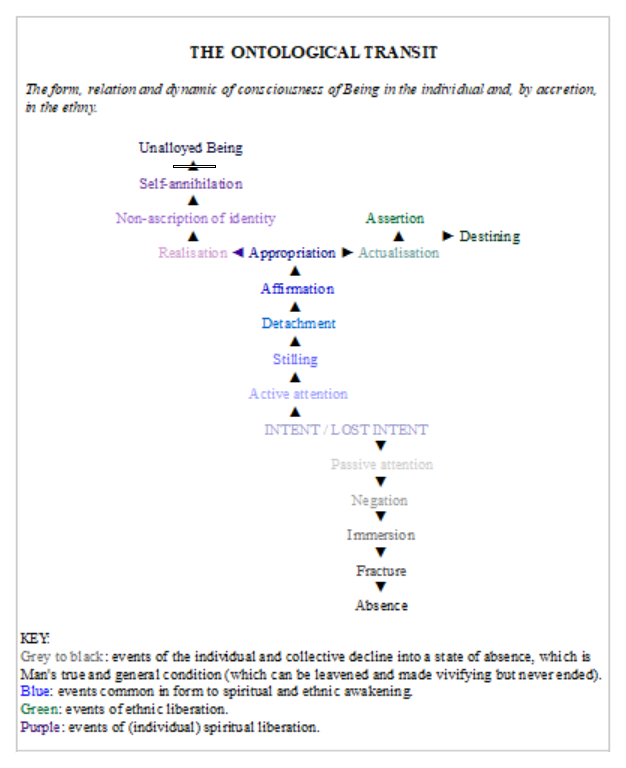
(iii) The “late” Heideggerian concept of Beyng as the praeternatural or first process, a factically manifest being as the foundation of All, disclosing and authenticating our (individual) being along with the being of everything in the similarly factic world. Heidegger spoke of a “rift” facilitating or opening to this most mysterious progress, which in turn he described as an “event of appropriation” - an active taking of ownership of the human subject’s being by Beyng rather than the subject’s being taking ownership of itself (or, as is the way of fallenness, mechanically imposing some constructed mental picture upon itself from personhood). Beyng’s event thereby reverses the current in the “early” model. As foundation, Beyng is causal without cause itself, the ground without ground itself, as well as the medium by which Heidegger’s ultra-elusive, totally speculative and millenarian “Last God” will fleetingly “pass by” sacralising human existence. Thus the concept transcends foundationalism itself, and takes us into questions of ultimate origin and ultimate destiny. Origin-wise, defenders of Heidegger’s concept argue that foundations for entities may exist but are themselves unfounded. However, the present state of knowledge in particle physics is that quantum fields are the final, filmy and universal ground upon which particles form under conditions of excitation, to combine as atomic structures. A claim that Beyng or any mysterious “something” founds quantum fields would transgress against the falsifiability principle. As long as a thing, and not no-thing, underpins the creation of the physical universe then Heidegger’s Beyng is rather more likely to be the being of some thing or things - perhaps the totality of the being of all things, be they ontic or ontological. But in any case Beyng would then be not groundless ground but a process dependent on the being of beings; and we would have no need of making human being subject to it. Let us proceed accordingly. My own (probably crude) attempt to address these matters in strictly cognitive and non-religious terms is titled The Ontological Transit:
This arrayal: a) Gives to fallenness a place in the overall scheme (the taking of which by the authors of religious texts then religionizes everything that follows). This destining of kin and kind is an extremely important qualification, removing from us the ornaments of pseudo-religious thinking (not only of Heidegger’s belonging to a being that is “groundless ground” but of liberalism’s more worldly and post-Christian lodestar of the subject without confines). It acknowledges the key distinction - most overt in Islamic mysticism - between union with the All and self-perfectionment, grounding, generalising and socialising the latter. It assays human causes and finds for Nature. It is perhaps the cognitive end of a long line of separation and difference which begins in the creation of organic life itself (to which we will return below). By way of explanation of the Transit an older essay divides the the whole progress thus:
Of course, every generation of thinkers since Plato and Aristotle have poured over this whole matter, some in more religious terms than others. A common non-religious conclusion that avoids agency for the All is for a prior, fundamental openness or space in which being becomes itself in a receptive universe (an obvious parallel being a painted image which cannot be produced but on a canvas or similarly open and receptive medium). Whether there is some sub-atomic, causal truth to that idea or whether Heidegger is right, or whether both are interpolations from elsewhere in the mind-scape, is a question for another time. Either way, for our purposes, as seekers of a life-philosophy for European Man at what is otherwise his end-time, Heidegger’s whole line of non-foundationalist thought has no obvious agentive product. It cannot be scaled directly to populations. Technically, therefore, it’s the wrong focus. (iv) Being as the organism’s be-ing, our singular and essential act of ongoing in the face of Time and Entropy and Happenstance, which latter is the actual cause of all that is organic. Heidegger made the ontological claim not for ongoing-ness as such but for existence. “Man alone exists, all other things are,” he said. In other words, while the temporality of all other beings is fixed at (actually adjacent to) the single point of Time’s progression, Man’s temporality renders him historical and futural. This is true within its own terms. But they are narrower than they might at first appear. Animals are futural in the reproductive fundamentals of their being, both in the reproductive drive itself and in the raising of their young; and while one could argue (actually speculate) that they are unaware as to why, still from a purely existential standpoint they are futural. For the being of men and women too, the same instinctual bearing abides. So we find that in the case of the transmission of life the Heideggerian distinction requires an understanding of futurity which animals do not possess, and all of a sudden we are not simply or solely in the realm of being but also of Mind, and the pure existential analytic has broken down. Obviously, repairing it requires futurity to be inherent to human being. It must be caused, and it must cause. Accordingly, we can say that it is linearity - being’s reactive processing of Time’s temporality – which orients being as futural. But if we then consider this processing of temporality a little further we may conclude that linearity necessarily implies a generalisation from “the single point of Time’s progression”, even though being never actually departs that point or moment. The content and form of being thereby acquire a different and offset relation to one another, the content remaining as focussed as that of any animal, and as fixed as any object, and the form orienting. As it does so something interesting and somewhat akin to Heidegger’s temporal division of Man and “all other things” takes place. Time’s positive gifts to human being, which are the light and energy of active presence at the single point, that razor’s edge of Time, also generalise, orienting with futurity, positivising it, and becoming causal themselves in a grand gesture of ongoing, not mere static existence. This, then, is causally of interest to us as seekers of agency and renouncers, therefore, of mechanicity and deficiency. But what of Heidegger, “early” or “late”. Well, he remains an immensely valuable figure, not only as an original thinker and a champion for renewal of the Western canon, which so completely fails the race of Man from whom, and for whom, it was extrapolated, but also as an avowed and instinctive Swabian identitarian who reasoned towards a Weltanschauung and a systemic politics fit for Germans and for all men, without definitively arriving there. He was one of us in respect to liberalism, modernity, techne, and the Jewish paradigm, if someone whose thought gestured towards nationalism rather than someone thinking on nationalism. He showed foundation rather than reaction to be the enduring point of intellectual departure and the human truth to be the way. As noted above, it has not proven possible to develop a functioning philosophy out of his thought. For one thing, it does not extend to a systematic structuring of causality. In fact, his account is unstructured, a jumble of ontological principles, chief among them Being-in-the-World, Dasein, Being-Toward-Death, Being-With, Dasein’s Care/Concern for its being, Beyng’s ownership of being, and so on. Some of them, certainly, must be adjudged primordial. But some are surely contingent, and one or two may not “be” at all. For example, we are informed by Heidegger that “the They” is primordial and, in consequence, belongs to “Dasein’s constitution”. Happily, “the They” does not refer to transsexuals but to ordinary folk ordinarily unthinking about their own enworldment, and thus immersed in the social forms du jour, including religious forms, all of which Heidegger saw as the sign and source of inauthenticity. Well, in my understanding, enworldment as the parent of personhood applies as much to philosophically aware – even notionally self-aware - intellectuals as it does to the dog-faced denizens of “the lower orders”, and personhood is as much a matter of mechanicity for one as it is for the other. We are all “the They”. Yes, there is a methodological line to be drawn, but it is not drawn by relative intellectual ability or even by a philosophical take on life, but by a particular use of the attention. The latter fact effectively compresses the whole of Heidegger’s position on “the They” into the term “ordinary waking consciousness”, regardless of anyone’s intelligence and schooling. But, then, consciousness and psychology generally were non-ontological tools he vigorously eschewed. He was always likely to draw his line in some intellectually exclusive quarter, which could not be without cost to his project’s potential. Another issue is that Heidegger’s concept of Care, like his concept of Time, effortlessly expands beyond all limits, to the point where he declared at various times that “Being is Care” and “Being is Time”. Obviously, he did not mean that these are synonymous and interchangeable. But the effect is to over-generalise the whole question of constitution, which might be considered unhelpful. As an explanation for life’s tenacity, Dasein’s Care implies that the being-there of a being settles (what is) a definite human emotion on causality. But carrying any value or preference … love or hate, compassion or indifference ... or, indeed, any cognitive product of Mind into primordiality, no matter how generalised and de-contextualised it may be, how distanced from ethics as such, is an interpolation. If one eschews Heidegger’s less than disciplined focus on human there-being, and thus such ornamentation of the bare, biochemical mechanics of the organism as “preferring for” or “willing” being over non-being, we perforce arrive at the conclusion that those mechanics existed before Homo sapiens, before sapience itself. There cannot be another rule for Homo sapiens whereby the driving truth of all organic life at all times in its 3.5 billion year history does not drive him also. It is only reasonable, then, to conclude that they are no less part of being human than any non-human life-form, are cellular in origin, reflexive and abiding, and therefore Mind-independent. Thus we have to look not for preference or will or any working of that less than stable entity, Mind, but for a mechanical and insuppressible recoil which might have the appearance to us of preference or will, and to which these latter things are easily and anthropomorphically imputed. To be clear, then, and in principle, everything must begin in the ultimately prior, and emerge whole from what comes before, each stage in the sequence being a causatum and environmental modifier for the next. For the reason of stage-modification alone, it is a methodological error to interpolate anything at all into the causes of life’s tenacity. It is sometimes said that Heidegger never fully relinquished the Catholicism of his youth, and perhaps Care is a sign of that. After all, CST is founded on the belief that Man is made in the image of a God “who so loved the world ...”, and so forth. The possession of a faith capacity blinds men from the otherwise obvious fact that the needs of faith in the mind create a fulfilling God, not the other way round (upon the verity of which the whole universe is, of course, silent). It is a failing against which the humble ethologist Frank Salter, working scientistically from the opposite direction (ie, from genes towards ethics), is proofed. Doubtless, both he and Heidegger would (at least formally) accept that the universe is the product of the perpetual and dynamic interaction of forces and mass, and not of design; and the appearance of life on Earth likewise. But whether Salter could explain more readily why genes have interests than Heidegger could have explained why being-there-then has values is another question. Neither could have been there at the first moment of difference - that is, difference between integration of proto-organic matter and its sudden and complete re-claiming for mechanicity by the disintegrating forces of the universe. Interest and Care alike are, at best, later developments. But they may just be interpolative errors made without the author’s need for a time-ordered origin in which neither is emergent. Indeed, emergence is surely the key to the whole issue. Let us look a little into that question. As identified in Part One of this series, a reductive or evolutionary approach to such a question necessarily involves:
Anyway, at this moment, and notwithstanding the differing methodologies involved and the vastly different intellectual standing of the pair, I judge Salter’s model to be the more fundamental because of its starting point, and therefore the closer to the “reflex, impulsion and movement” - reflexivity, for short - mentioned above. This is what I believe to be the plain fact of life’s tenacity (which we might only ornamentally call, “the sole imperative of a primordial will to continuity”) in critical contact with “the cold state of mechanics”. It should be remembered that the organism’s origin is a result of inorganic processes occurring under those same conditions (because they are constant and universal). Origin means integration within confines which gift separation and difference, but only until the organism is reclaimed by the cold state of mechanics, as it must be in time. Part One puts it this way (framing the contest as between essence and existence, but the meaning is clear):
This novel reductive or evolutionary analysis allows us not only to critique Heidegger and Salter on this narrow point but to go beyond interrogating both Dasein and natural ethics. The final point of arrival is a singular and perpetual re-energising of separation and difference, by which origin was and is sustained on contact with that equally singular and perpetual “cold state of mechanics”. What is ultimately “there-then” - and “here-now”, of course - is pure recoil rather than an interest, a preference, a will, a care, (each of which also express it, or part of it, but through the filter of higher mental function, and thus never more than proximately). It is causally, temporally, and ontologically prior to the act of extension that is being as ongoing-ness or differentiation, which is itself only possible because recoil exceeds the requirements for such. In excess, it masses its actions against disintegration such that being itself is a work of flowing and radical increase. At the risk of repetition and to be perfectly unequivocal, it is this utterly insistent, primordial and constitutional energy which propels be-ing. Thought and feeling only come after. If Heidegger’s very general claim for Care is open to question, so is his claim for Time and temporality. As claims go, it is extensive. In The Basic Problems of Phenomenology, a lecture paper from 1954 but published post-mortem, he wrote:
In the round, Heidegger rated Space as strictly subordinate to Time. Neither as the universal fabric nor the Cartesian situant of all matter was he especially interested in it. Similarly, the conceptual unity of theoretical physics, in which Time is always local, seems to have held less appeal than it might, given its gradual emergence during his formative intellectual years after Einstein’s preliminary paper on Space-Time, which was published in 1905 and worked up to a general theory of relativity a decade later. So it was very well established by 1923 when Heidegger closed the door of his hut behind him in Todtnauberg and commenced work on Being and Time. In the event, he proposed that being flows beyond location and into an extra-locative with-ness demonstrated by the exchange of gifts and love-letters at a distance, or likewise the entering into contracts, giving of legal opinions, sending diplomatic notes or, in our age, playing chess online or visiting a message board. Locales may de-severate, as he put it. However, it’s a category error. Words are read at a distance, not being. Emotion and intellect and personhood, and not being, are in words, as they are in music and art and architecture and every product of men, and all such goods have their own essential but ontic being. The essence of culture itself is ontic. It which may express or reflect some characteristic of the person or the person’s Mind, but being is not that characteristic. Likewise, while the sociobiological traits of Mind ... the permanent, natural traits ... will always be-there-then in being, for they are in the ontological sense; but being is not those traits. We have to be discipled about this. Our subject is not human beings, and not the human being-ness of human beings, not the communications of human beings, not even the nature of human beings. Human being ... ontological being ... is solely that which is “there-then”, contained by the razor edge of Time until it is no longer such; as in time even words and music and art and architecture no longer are. All integration must dis-integrate, and leave a void the totality of which Percy Bysshe Shelley captured very much better than I can:
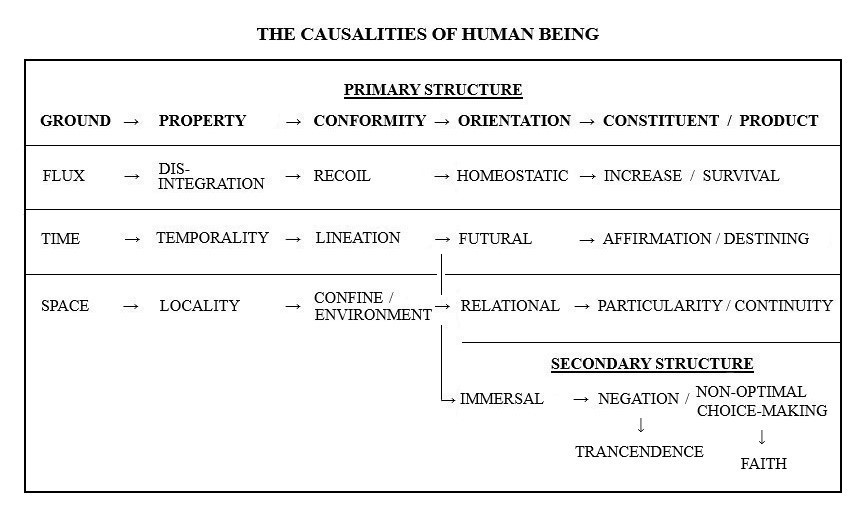
I might just point out that the being of poor, drowned Shelley is not “here now” as we read his words, and nor would it have been during his brief lifetime. The mutual absence would have been the same then as it is now. In effect, what Heidegger did was to pull his concept of With-Being so far beyond its razor-edge existential dwelling that it took on a curious and unwarranted temporal fluidity, bridging between locales at which, factically, it is not and could not be. With-ness alone, if detached from being, may attach itself to desevered relation. As soon as being is introduced it turns to dust, for the place of dwelling of with-ness is temporally different to the place of dwelling of being on the razor edge, and in no wise dependent upon it or emergent from it. All that said, other thinkers, notably Jacques Derrida and the postmodernists and, latterly, the German essayist and hyper-modernist Peter Sloterdijk, have sought to balance the books and give being its due fixity. To that end they have presented locale as the primordial field of ontological realisation, in which any living being takes on its ownmost truth. That more disciplined approach is surely right, and not least genetically - the most interior factical Withness. Being is not in genes. But genes are in being, colouring and characterising the relational organism which is. The aforementioned proponents of human sameness, and thus the universalisation of human truth, would doubtless dislike the thought that the philosophical truth of beings and their too too solid physical reality have a common spacial cause. Notwithstanding that very final rupture, we proponents of difference and multiplicity and relation can still favour their approach to locale. Meanwhile, if locales do not de-severate is there anything that might perform a similar action? Well, below I propose that an integrated entity, a primordial vita, responds to the ground of locality as confine. The deseverator that is relation appears, duly confirmed by particularism. One can comfortably extend that argument to genotype as a traveller in Time and a unifier of the temporalities of phenotype but, given relation, a singulariser or particulariser of locale. Of course, to make the shift work at all one has shifted clean out of ontology and into biology. But perhaps that shift is a licence granted by the original category error! Returning to our ontological furrow, we now have one further task remaining to us, which is to supplement both Space and Time with a third cosmic determinant. We have already mentioned it just above. It is the ceaseless flux of mass and energy in Space-Time. From its cycles of integration and disintegration arise all material creation but also all systemic decay. In the Heideggerian context it supplies the cessation of the organism’s being, without which Heidegger’s commentary on Time and temporality would have no dynamic content, for there would be no approaching end towards which organic being must ineluctably face. Dasein’s futural (but never purposive) standing could not be conceived. THE CAUSAL STRUCTURE The table below proposes three principal grounds, each working through the same short, staged sequence of causal inter-actions with primordial being and human being alike, since Ground does not change. So, Ground as, say, Time is obviously distinct from its power of temporalisation. The distinction is that between the advancing “now” which spacial motion generates and the singular “now” as it localises. Both characterise the universal fabric as a whole. Thus temporalisation is the attenuating property of Time in Space. In our table it acts as a causatum conditioning the rightward sequence as a matter of absolute law and universal government. As such it disposes of human being, but not only human being. Everything, organic or inorganic, is subject to it from origination, dependent upon it and under conformity to it. Accordingly, Time-as-Ground and its property are not in themselves responsive or relational to what they temporalise. They are as indifferent as is the wind to the waves. For example, they are not primordially relational to human being. Human being is the responsive party, relating and orienting reflexively to an implacable detachment, mechanistic, everywhere cold and void-like. None of the three Grounds port or impart meaning. Meaning would require design, and design would require Mind. In the broadest terms we are accident or we are design, and if we are design then everything is design, everything is meant and has meaning. But no part of Man’s factual knowledge ever demonstrated one scintilla of design. Faith in design is an exercise of the higher emotions. If we exclude it, therefore, and guide ourselves only by what we know and, presently, can know, we really are left with a life in a universe of forces acting blindly upon us as an organic anomaly, just as they act upon everything. The perpetual question for the study of cause, then, is wither fact or myth, and if our way is selected for us by fact then we cannot rest. Only the faithful can rest. We are obliged to uncover being’s coherent developmental sequence as it is conditioned by ground. That sequence must yield being’s founded solidity, such that the human truth may then flow and all our historical and historiographical factors, with which this essay began by listing, may be compared to it without favour. With that, we will proceed to the proposition. It isn’t remarkably radical. There are no surprises. After all, we are dealing in the common currency of human fundamentals. This is detection, not invention, and once detected the outline ought to be reasonably apparent to any Philip Marlow of ontological investigation. Detection extends to the only novel element in this investigation, which is the (tolerably tight) sequence, whereby final products articulate from an at-hand given ground:
One should acknowledge at the outset that an evolutionary ontology will always be narrow in focus and fact-bound compared to the philosophical norm. For example, in his late epistemological thinking Heidegger developed an aesthetic theory of four-fold being, the four-foldness comprising earth, sky, divinities, and mortals. His assertion was that humans dwell in a given natural or nurtural relation with these. It feels like a foray into the structure of experience advanced via allegory for the purpose of holding up the rest of the proposition. It may also be an attempt to integrate the transcendental into the everyday or exoteric life, or to sacralise that life. Whichever it may be, it is very far from a model of “narrow detection” with “no surprises” that I am attempting to perpetrate right now upon you, dear reader! Anyway, methodically right or wrong, we are now embarked upon a quest for constitution – the real, inhering, causal grounds of human being. The primary structure This investigation has identified three grounds, interlinked certainly but each inviolate and unsurpassable in its own domain, and together constituting the All: (i) The ceaseless flux of mass and energy. We have also touched upon ground’s property, which is the aspect of constitution to which all matter is directly subject. While conformity to it is inevitable and, of course, conditioning, still the precise outcome lies with the construction of the subject entity, in this case an entity whose separating, differentiating construction, for example, recoils from disintegration. We are then investigating being as it emerges from that first stage and unfolds. To a greater or lesser extent, that thing emergence conforms within its own range of reflexive possibility. What is reflex? As a practical example, its presence may be inferred in the “survival of the fittest” evolutionary strategy. So, say, common household microbes with genes most conducive to resistance tend to survive serial applications of a chemical-based cleaning agent such that, over time, an increasingly resistant population arises. The conforming act in that case is not only the extinction of large numbers of the population but also its orienting towards greater resistance, thereby maintaining its state of differentiation from “the prevailing All”. That struggle never ceases. While the above example is drawn from the line of flux - or Flux - those of Time and Space proceed after the same fashion. The separating, differentiating organism cannot be as inorganic matter is before Space-Time’s respective and co-active properties of locality and temporality. It cannot be arrested in either as mere lumpen matter is arrested. Its separation has a vote on the question. Après Heidegger, Time is “an issue for being” because Time is consonant with disintegration. From the Part One essay again:
Heidegger wrote at length about our formative experience of past → present → future, representing it as a product of Dasein’s temporalisation. “The future is not later than having been, and having been is not earlier than the Present,” he wrote. We need take no issue. We are not discussing here whether Time is indeed linear or is in some hidden way non-linear, but how linearity is human being’s singular reflex under temporalisation (as are the other two reflexes which we shall cover below, in relation to the like impacts of disintegration and locality). As for Time’s linear form, it indeed may be a fair copy of the thing that is or it may not. But it is what is possible for human beings and their fondness for prediction and is, therefore, a starting point for an ontological consideration of human being. Always, it must be said, that is being not as mere factic there-ness, which is the passive there-ness of any physical object at its point in Time and in Space, but as being in its ceaseless, reflexive struggle in the cause of difference, and the ongoing of difference, from the cold, homogenising mechanics without. In the most basic, primordial sense, then, it is difference’s conflict with homogenisation - Ground’s final and singular action incorporating the existent object into a cold, black, ontic totality - which inheres reflexive impulsion and directionality in organic being. On each specific Ground, therefore, there manifests a cascade of active and radiant emergent processes orienting being towards life and life’s continuity. The suzerainty of mechanics recedes - at least for a time - and human being flourishes. In the temporal context reflex is relatively weak. But a strong reflex (recoil in the table) manifests where entropy and Happenstance are most immanent, namely on the ground of “the ceaseless flux of mass and energy”. Here it is being’s only possible recourse to orient itself away towards homeostasis as a perpetual securing of another ground (of sorts), a ground with some stability, some insusceptibility upon which an immediate survival may be gained. It is, though, still always and only a partial rebuke to disintegration even in the broadscale genetic terms noted in Part One.
As an existential condition partiality always contains within itself the possibility of imminent disintegration, and thus the certainty of continuing recoil. The latter seems to have no stopping point at actual homeostasis, at least not as mere sufficiency. On the contrary, the winning of some stability only occasions another leap towards immortality. That is doubtless calibrated to sheer Happenstance and the manifold insecurities of each and every environment of evolutionary adaptiveness (eg, disease, famine, natural disaster). Hence, for example, Nature’s seemingly downright cruel precaution of the earliness of puberty in humans in the face of child mortality and the ravages of famine and disease. Hence the intelligence of the three northern hemisphere races. Hence techne in all its forms. It all speaks of a natural devotion to excess well beyond the requirements for basic ongoing-ness or differentiation, attended by a rude and vigorous ardour hardly contained within Heidegger’s discrete concept of care. The previous statement suffices:
It is this driving increase, therefore, which imbues human being constitutionally, and gifts human life its vast energy for and variety of endeavour. For its part, locality-as-confine is the site of the primordial vita whose extreme fragility would otherwise be exposed to “the vast forces without”, and whose physical integrity would be quickly undone. Apparently, Derrida spoke of a womb, and perhaps he also had in mind this idea that life’s coming into being is an event which could occur only in a certain confined locale. Confinement, of course, was a nineteenth century term for restricting a woman’s physical openness to Happenstance during late pregnancy. By comparison, Confine in our context is the necessary precondition for viability in that second accident which is vitalisation of the primordial organism. Confine does not know vita as the womb knows the foetus, of course (and if Derrida is speaking of this idea then he is doing so poetically and not philosophically). But vita knows and relates to confine, or relates to it enough for the organism’s act of attenuation, its “reflex, impulsion and movement”, to proceed. Confine, meanwhile, does not change one whit in itself and, vita aside, does not even exist for its contents except as an accidental locale to which everything, even Time, is subject. As Confine, though, it is a fact only of vita’s relation of dependence. In that relation, certain particulars of confine facilitate the emergence of human being from a primordial vita’s first enduring. It is being’s particularity, then, which transforms confine into an environment in the classic Darwinian sense as a process-bound causatum of ever-increasing differentiation in which relational dependence always moves towards relational independence (and specificity). Of course, it can never truly arrive at independence, not even with cloning and transhumanism. Mortality ... disintegration ... remains always at hand. But still the direction of movement is clear. For example, the pure mechanism which attended the first transmission of traits for fitness eventually emerges in the higher mammals as selection, and in Man as something closer to an exercise of the will. Similarly, in the human history of his techne from the first hand-tool, and most especially in the sublime trajectory of independence which is the life of European Man, we finally see Nature itself brought ever more under his audacious hand. This entire history of relation is given over to particularity. It is particularity which is constitutional to human being in his spacial context. The wicked and deliberate flooding of European living spaces today with foreign peoples, and the imposed political culture of human sameness and racial equality, is precisely a stamping out of particularity in the European being, by generational replacement and by miscegenation. It is a forced disintegration. We will conclude by returning to the temporal context, which we left at futurity. As noted, being’s orientation towards the future never actually leaves the present moment. Orientation is a generalising form by which being covers more than one time-scape. But its content is forever fixed on a single point. In its most free expression, being emerges – Heidegger would have said unconceals – with “normal” consciousness of, or presence to, that point and before the world. We know it as an emergent and reclaiming self-affirmation and appropriation, a home-coming. Heidegger spoke of ecstasis but I struggle to see how one might make a convincing case for a transfer or separation of content in that sense, given Time’s present-hood, and given that, by its sheer, blazing tenacity, content is its ownmost self and commands from the centre of itself. Rather, like the flaring of the sun futurity properly inheres in that same massive and motile positivity. The restless power to live life intentionally is available and the future is full not of the heavy foreboding of death but of life’s destining possibility. Thus futurity finds the fulfillment of itself. Apologies for the polyphony, but the opening Allegro vigoroso of Michael Tippett’s little-played Second Symphony from 1957: ... is 8 minutes 6 seconds of the pure and primal energy and massive, abiding optimism I have been trying to convey. Just the forging reverberative chords and the commanding brass above offer the sense of that. You need to begin listening a little way in, though, since at the piece’s live premiere by the BBC Symphony Orchestra in 1958 this opening section went awry. The conductor Adrian Boult halted everyone, apologised to the audience and began again (at 2 min 45 sec in the video). Polyphany, btw, which somewhat ironically became a cultural artifact of the period, was intended to free composition from all cultural attachment. In our case, that tender hope of cultural detachment must stand for the disentangled abstraction we need for this pursuit of constitution (which can never really end, for understanding is unquantifiable). On that musical gesture we will end for now. We have arrived at a three-fold constitution of increase, affirmation and particularity. In the next essay in this series we will investigate the secondary structure which exists by an error of Nature, and from which we humans derive error everywhere and the saving evolutionary strategies of transcendent action and religious feeling. Comments:2
Posted by Guessedworker on Thu, 14 Sep 2023 06:35 | # It was taken down several years ago, James, because it was inadequate in scholarly terms, and the work of bringing it up to scratch was too consuming of our time and effort. I will have a root around in the directories and, if I can find it, see what whether it might be brought back as a post. 3
Posted by Richard Yorke on Sun, 17 Sep 2023 16:44 | # How can a person select in a way that is positive to nationalism, what is being selected for? Youth/Innocence? A person has to have either affinity/sincerity, or faith/courage. So Heidegger supports a plurality of destiny? that doesn’t make sense. “Ye must be born again.” To whit I wonder if the American nation will be born again? If it be established on divine providence. Being English I kind of feel it wrong that people pay taxes relating to their home, though others see it as a duty, street lights, roads, schools. Though perhaps my conception is wrong (Of English)? What is it to be English or Anglo-Saxon. 4
Posted by Guessedworker on Mon, 18 Sep 2023 06:39 | #
One selects for something and against anything else. A conservative selects for some aspect of conservatism (individual freedom, say, or self-reliance) and rejects anything that is of socialism. But such a person still belongs to the zeitgeist ... still lives in the horizontal plane, close to the worldly surface. He hasn’t developed a question of that surface or a deeper and more instinctual sense of human truth. It is, of course, that sense which leads him by degrees into formulating a new critique and negative valuation of the world about him, and finding its politics unsupportable. He quite naturally turns towards where (what we might call nationalist) truth and light and value lie, and begins to understand that, in rejecting it previously, he was acting out of suggestibility and conformism, such that everything he thought he knew about nationalism was wrong. Thus the journey of discovery begins.
The table of causalities is mine, and seeks to capture the essence of human being as a threefold or constituted unity. All constitution has plurality at its source. The plurality here derives from the irreduceable foundations on which being rests: time, space, and the constant flux of matter and energy. Each produce a specific imperative - really a human essential, without which being is not possible or complete. We humans must survive, we must have continuity, we must act accordingly. If a worldly Power constrains us to act in such a way that we then hold our physical survival or our genes on the soil to be insignificant or even wrong, and to strive only to apologise for the immorality of our cause, then not only the truth of that Power must be exposed to the light, but our own human truth must be rediscovered and made regnant. Making that regnancy is nationalism.
Rebirth is not an existential possibility. Heidegger spoke of “Eriegnis” or disclosure ... unconcealing, if one wants to add some human agency to it, because the awakening of which nationalists speak is a rediscovery of who and what we are, and what needs must flow from that.
We could be Scottish or Welsh, or French or German, but you and I are English. We are sons of English mothers and fathers and kin to all the English people, and only to the English people. This is not some social confection. This is the truth of our very being, which is shared. Thus our survival, continuity and destining is precisely that of our whole people, and not merely of our petty selves. 5
Posted by Al Ross on Wed, 20 Sep 2023 04:55 | # GW , your last heartfelt and admirably patriotic sentence could well have been constructed by my late great hero , Enoch Powell , and he , as we all know was of recent Welsh descent. 6
Posted by Richard Yorke on Tue, 26 Sep 2023 05:39 | # I feel I know next to nothing about the UK really. Even being English, there is a vast difference between the home counties, the midlands and the north. Between people living on council estates and people in the suburbs, in general. Effectively with the exception of Kent and Wales in the past, the UK is still under a kind of feudalism. London and the East Midlands are effectively gone. The massive immigration from Eastern Europe saw to the East Midlands, looking at minority English in many areas near where I live. People in fortuitous circumstances have abandoned ship for Australia, New Zealand and Canada; which can be said are more English than England. Strictly put, what is to distinguish being regnant, between that and a “Will to Power”, a pure material outlook. What does one English person really have in common with another. Individualistically people in the south are more likely to do their own thing if left to it. The UK though is severely depleted of resources and not as egalitarian as many other countries, given the historical wealth disparity and collapse of the middle class. Bloody Karens. What commonality is there? England is laid waste, indoctrination central, in a way that makes ‘1984’ some what of a dream. To me religious belief is the thing keeping me going, in a world of darkness. Though it’s only a particular view of Christianity(The New Church) that is held by a few thousand worldwide, and my experience on Facebook is that I rarely see eye to eye, with those affiliated with. Yet to me it is true. Freedom… in a world, where people have 2.1 children and everyone lives under ‘Gavelkind’. No arseholes. Enough land in this green and pleasant land… But in general it’s not like that… Everyone having a stake in the land…, not enough land presently, going to be a bloodbath eventually. When even the rubbish collection system is a mess, I can’t see “Bladerunner” style cities working. The Whig Golden age of the UK reigns again…(ex 1st Earl Hardwicke, Philip Yorke, Lord Chancellor and Regent) and then only because the UK was massively outnumbered by France, Sweden, Russia, Austria, Spain. Most(basically all) of the wealth in the long time landed primogeniture Tory faction. 7
Posted by Timothy Murray on Tue, 26 Sep 2023 13:45 | # @Richard Yorke Read Logos Rising by E. Michael Jones. Dr. Jones creates a narrative of the patient work of Logos* in the world from the dawn of human history to today. It puts “us” in a robust historical context that gives us the tools to kick heathen ass. *per St. John in the opening to his Gospel God bless.
8
Posted by Guessedworker on Tue, 26 Sep 2023 23:17 | # A couple of observations, Richard. 1. Relation is prior to all socio-economic and cultural division. Before you write off your own English people, try living beside Africans, Arabs, and Asians. Alternatively, try tracing your own family back, say, twenty or twenty-five generations, ideally tracing each familial line. Then turn and come forward to the present, again marking all the children of every generation. You would arrive at a vast crowd of kin, perhaps exceeding a million in number, and representing no mean portion of our whole tribe. As to the rest, well, if you were able to go back far enough and repeat the process, you might discover your relation to every one of us alive today. 2. We do not have to talk ourselves into oblivion. No part of our home is “gone”. As a people we have to find commonality even if it is elusive today, because only thereby may we make politics which can secure the existence of our people and an English future for our children. What is foreignised today, therefore, must be de-foreignised tomorrow. It is very difficult, but it is also our only way to life, and it must be done. Don’t weaken or lose hope. Yes, much damage has been done. Yet, incredibly, it falls to each of us, excluded and dismissed as we are, to do everything within our power to bring this about - and to exhort our English brothers to do likewise. What a privilege, really. To what better end could an Englishman desire to devote his life! 9
Posted by Richard Yorke on Wed, 27 Sep 2023 12:46 | # To a large extent my feeling is to seal off London, the major cities, that they be a tomb. “Drag Ireland into the mid Atlantic and sink it.” What is politics? The Polis or City. In my mind there is a kind of conscious animus or masculine mind, that would use the military, duels, courts etc to resolve such a situation. Can’t see the cities being de-foreignized. saw a clip that Nick Griffin posted on Twitter showing Leicester, majority non-white now. The political class isn’t typically English, hasn’t been for over a thousand years. I can’t see animus(Logos) resolving the situation, people are inclined to tip the table over. Anima(Spirit) and the proper application of could. I know from looking into religion that the Swastika in Jainism, that Swastika… is a move towards the unconscious and habit. Though to me the symbol is “taking the Lord’s name in vain”. I try to filter things down now on a metaphysical level. I don’t tend to listen to Trinitarians for a resolution, I think it’s wrong, I think a One person metaphysic is correct. Religion adds another dimension to politics, I generally feel that nationalists are good people. If they religiously differ however, kind of a sense of taking a step back. Nationalists tend to be Trinitarian. My general sense though is the Whig Faction in the UK and later USA tended to support a One person Metaphysic. Between a National Socialist or a National Conservative, neither appeal to me. A National Whig has appeal, though the Whig party is effectively dead. A National Nationalist? Or a National National Nationalist? Is a Liberal Nationalist enough or too much. 10
Posted by timothy murray on Thu, 28 Sep 2023 02:33 | # Hi Richard
Evil has had its time, it is lashing out now, God is always true. “Behold! I create a new thing”
Frankly, I am having a blast watching Truth unnfold. Also, thank you for the distinction between soul and spirit…
11
Posted by Al Ross on Sat, 30 Sep 2023 01:41 | # https://www.youtube.com/watch?v=We2_myqkqNA God created Trannies , yes siree. 12
Posted by Al Ross on Sat, 30 Sep 2023 02:10 | # #10 Truth is unfolding in the West , where all the young interloper “migrant” Muslim males will acquiesce to Christianity’s polite feline requests and respect the milquetoast squeak : ” Please don’t groom our 12 year old daughters , because God/Jesus forbids it , but never mind you will, of course , be forgiven for ruining our lives and genetic future by rape - enforced miscegenation.” TM has a righteous understanding of Europe’s proximate future because that is what Christians demand. 13
Posted by Al Ross on Sat, 30 Sep 2023 02:33 | # Some enquiring minds may be tempted to ask , what is the practical application of Christianity to the raison d’etre of GW’s temporal blog ? Can Christianity aid White EGI , in Salterian terms ? You , Thorn and TM are like two Mormons chatting during a stroll between a Las Vegas slots venue and the nearest bar. 14
Posted by Guessedworker on Sat, 30 Sep 2023 21:41 | # Al, you ask:
On another thread I said the following in reply to James Bowery:
At a minimum de-Judaisation means voiding (a) the model of the sinning-then-saved individual, and (b) the model of the love of all humanity. Obviously, these are not part of any liberational or enlightening practik. They are atomising and universalising forces in the life of our people. 16
Posted by Al Ross on Tue, 03 Oct 2023 05:09 | # # 14 . Thank you , GW . Marcionism partially covers Christianity’s , temporary and overdue purported Hebrew exit, but for me it’s all simply Middle Eastern mythical Semitic cultural mulch. I like The Talmud , though. That puts Christians in their Noahide place. 17
Posted by timothy murray on Tue, 03 Oct 2023 22:36 | # @GW Christianity predates the jews
18
Posted by Thorn on Tue, 03 Oct 2023 22:57 | # “I like The Talmud” - Asshat Al LOL GW, Your admirer/student, Al, likes the Talmud. Did you encourage him to “like” the Talmud? Do you, GW, “like” the Talmud (as Al does) too? Serious question. It deserves to be answered. 19
Posted by Guessedworker on Wed, 04 Oct 2023 07:34 | # Timothy, the faculty of faith - an evolved complex in the higher emotions - might reasonably be said to pre-date its products of religions and their deities, because we can test that hypothesis based on the constancy of the former and variability of all the latter. But nothing faith insists upon can be tested. It is all circular. Thorn, the objectives of, respectively, Pharisaic Judaism and the early Christ-cult were the same, namely to inherit the mantle of Second Temple Judaism, which was disintegrating under the occupying military government of Rome (and which was finally smashed with the Romans’ destruction of the Temple in AD 70). Peter’s mission to the Jews failed. Paul’s mission continues to this day under the various church leaderships. You are part of that mission. Obviously, Al is not, and neither am I for the reason that I don’t have expressed genes for faith and don’t know what it is. I do, however, accept that those with it must live according to their nature, and so - for me - the only question is whether a given religious form adds to the genetic interests of one’s race. So if there are flaws in, say, our religious system which reduce our interests, then it is necessary to question that system. That is what Al and I were talking about here. Do you accept that the individualising and de-ethnicising/universalising characteristics of Christian doctrine derive from Judaism’s model for the a-causal, amorphous and servile gentile of Olam Ha-ba? That’s really the question. Do you not want to address it? 20
Posted by Thorn on Wed, 04 Oct 2023 11:14 | # Reality check. GW, over the course of at least the last 75 years Cultural Marxism has insidiously infiltrated our culture and now, for all intents and purposes, it is the dominate force. Christianity as it stands today has been subverted and or perverted by its ‘commie-pinko-fag’ enemies. Hence, it has been deformed by secular religions ... obviously (or in some cases not so obviously) many of which are disguised as or deceptively operate under the name of Christianity. DEI + CRT + ‘Antiracism’ = The War on Whites. (Of course, there are other dynamics at work against us such as globalism and all it entails such as massive migration non-white into white homelands, but I just named three biggies that negatively impact the psychology of the vulnerable White masses. They, in effect disable, render ineffective, whites’ natural EGI defense mechanisms. They were deviously designed to do just that!!) Put all your emotions aside, it is of utmost importance to first and foremost identify who/what our enemy actually is. It isn’t traditional Christianity. Traditional Christianity is a thing of the past. “Wokeism” is the new Western religion. Wokeism is the religion you should be concerned with. Wokeism is the Acquired Immune Deficiency Syndrome (AIDS) that threatens our EGI.
21
Posted by Guessedworker on Wed, 04 Oct 2023 13:40 | # To effect change to what regular people see as real, which is only the immediate effects and surface appearance, and to do it in any controllable and lasting sense, we have to reach into the causal action beneath. So, for example, to address the Jewish Question in a non-reactionary and morally validating way we have to understand how, to a non-trivial degree, we do actually live in the Jewish Mind. What power can we hope to wield if we do not inhabit our own mentational universe wherein everything is of us and for us? Our future cannot differ from our past because, even if we resile from the worst of today’s cultural trespasses, still we only step back and seek something enduring from where the same fundamentally alien causes abide. These things makes strangers of us to ourselves and suffocate our creativity. We should not be in fear of the radicality required to cut them out. 22
Posted by Al Ross on Fri, 06 Oct 2023 02:46 | # #17 TM you sound like a fundamentalist Muslim who insists that (((Abraham))), ( forgetting Zoroaster, who invented group - accepted monotheism - yes I know an Ancient Egyptian King imposed it but it did not long survive him in tribal group terms ), was the “First Muslim” because he “submitted” to the old Jew god. The Middle East is a horrible place. It was then and it is now. But still, the Semitic nonsense which emanated from that Jewish cultural cul - de - sac remains your moral compass. Your moral compass points South. 23
Posted by Al Ross on Fri, 06 Oct 2023 02:54 | # “it deserves to be answered” . #18 Well , perhaps I might suggest that GW , infinitely laid back as usual about my unacceptable ( to nitwit Christians ) Weltanschauung , gives two fifths of fuck all at the double for your inane enquiry. 24
Posted by Al Ross on Fri, 06 Oct 2023 06:46 | # Theologically , there is so much foreskin room between Jews and their American Christian , Noahide, enthusiasts. Post a comment:
Next entry: Out of foundation and into the mind-body problem, part four
|
|
Existential IssuesDNA NationsCategoriesContributorsEach author's name links to a list of all articles posted by the writer. LinksEndorsement not implied. Immigration
Islamist Threat
Anti-white Media Networks Audio/Video
Crime
Economics
Education General
Historical Re-Evaluation Controlled Opposition
Nationalist Political Parties
Science Europeans in Africa
Of Note MR Central & NewsCommentsGuessedworker commented in entry '"If America doesn't learn ..."' on Sat, 18 Apr 2026 16:23. (View) Thorn commented in entry '"If America doesn't learn ..."' on Sun, 12 Apr 2026 20:35. (View) Thorn commented in entry '"If America doesn't learn ..."' on Sun, 05 Apr 2026 23:35. (View) Thorn commented in entry '"If America doesn't learn ..."' on Mon, 30 Mar 2026 15:40. (View) Thorn commented in entry '"If America doesn't learn ..."' on Mon, 30 Mar 2026 11:43. (View) Guessedworker commented in entry '"If America doesn't learn ..."' on Mon, 30 Mar 2026 07:08. (View) Thorn commented in entry '"If America doesn't learn ..."' on Sun, 29 Mar 2026 11:56. (View) Guessedworker commented in entry '"If America doesn't learn ..."' on Sat, 28 Mar 2026 23:31. (View) Thorn commented in entry '"If America doesn't learn ..."' on Mon, 23 Mar 2026 22:55. (View) |

Posted by james on Tue, 12 Sep 2023 10:32 | #
do you guys still have that FAQ you did about race ages ago? i remember it being seriously excellent but can’t find it anymore